
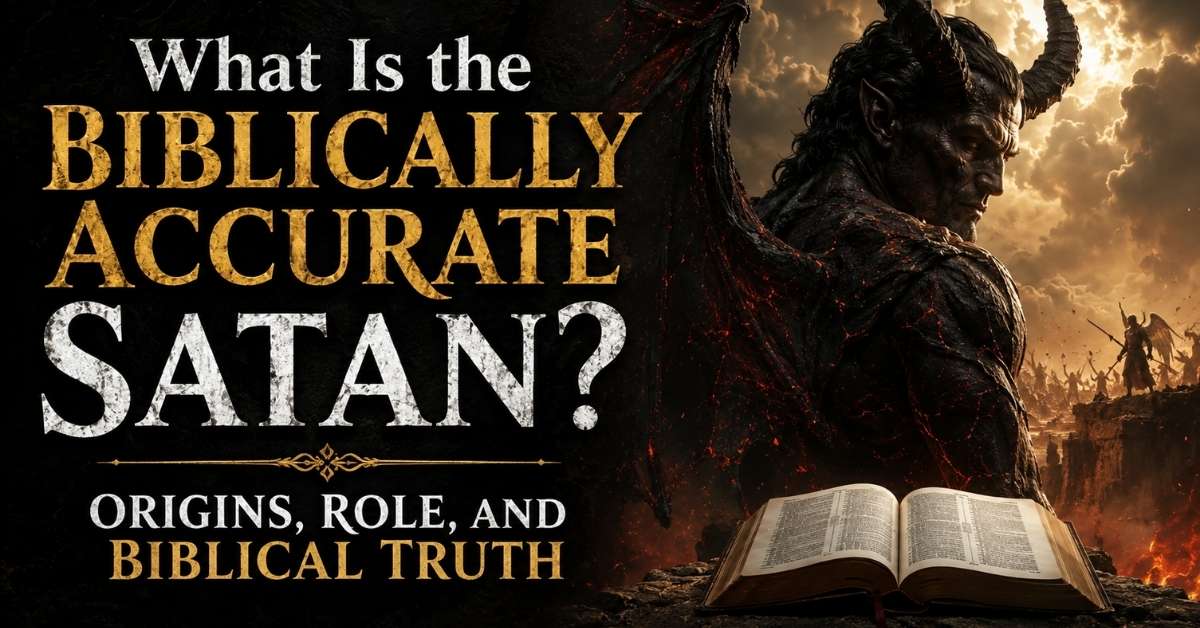
Pop culture shows Satan as a red horned figure with a pitchfork. Scripture shows something very different.
The biblically accurate Satan is a title, not a fixed image. It means “the adversary” or “the accuser” in Hebrew. This figure appears rarely in the Old Testament and takes on a larger role in the New Testament.
This article breaks down what the Bible actually says about Satan. It covers Hebrew word origins, key scripture passages, the Lucifer debate, and how Jewish, Christian, and Islamic traditions understand this figure differently. You will get a clear, source-based picture instead of the horror movie version.
Understanding the Biblically Accurate Satan in Scripture
The Hebrew Concept of Ha-Satan
The Hebrew term is “ha-satan.” It translates to “the accuser” or “the adversary.”
In early Old Testament texts, ha-satan is not a proper name. It is a functional title, similar to calling someone “the prosecutor.”
Key points about this term:
- It appears with a definite article (“the”) in most Hebrew Bible passages
- It describes a role or job, not a specific individual’s name
- The word can describe human adversaries too, not only spiritual ones
For example, in 1 Samuel 29:4, Philistine commanders use the word “satan” to describe David as a potential threat. This shows the term originally had a broader, non-supernatural use.
See Also: What Does the Name Tristan Mean in Hebrew? A Biblical Perspective
Satan’s Transformation Across Biblical Texts
The concept of Satan changes shape across the biblical timeline. Early texts present a limited, functional adversary. Later texts present a more defined spiritual opponent.
This shift did not happen overnight. It developed gradually across centuries of Jewish thought, especially during and after the Babylonian exile.
A simple timeline of this development:
| Period | Text Type | Satan’s Portrayal |
| Pre-exilic Israel | Historical books | Human adversaries, no supernatural figure |
| Post-exilic period | Job, Zechariah | Heavenly prosecutor role, still subordinate to God |
| Second Temple period | Non-canonical Jewish texts | Expanded, more independent evil figure |
| New Testament era | Gospels, Epistles | Direct opponent of God’s kingdom, tempter, deceiver |
This table shows a clear pattern. The figure grows more distinct and more oppositional over time.
Distinct Roles Across Old and New Testaments
The Old Testament Satan operates inside heaven’s court system. He appears before God, as seen in Job 1 and 2, and needs permission before acting.
The New Testament Satan operates more independently. He tempts Jesus directly in the wilderness (Matthew 4:1-11) and is called “the ruler of this world” (John 12:31).
This is a meaningful shift in scope, not just style:
- Old Testament: Satan reports to God’s council and works within limits
- New Testament: Satan actively opposes God’s kingdom and tempts humanity
- Old Testament: rare, appears in only a few books
- New Testament: frequent, named across Gospels, Epistles, and Revelation
Understanding this shift is central to any biblically accurate view of Satan.
Characteristics of the Biblically Accurate Satan
Satan’s Functions and Symbolic Significance
Scripture assigns Satan specific functions rather than a fixed personality profile. He accuses, tempts, and tests.
In Job, Satan’s role is to test Job’s faith through suffering. In Zechariah 3:1-2, Satan stands to accuse the high priest Joshua before God, and is rebuked.
Core functions found in the text:
- Accuser: brings charges against people before God (Zechariah 3, Revelation 12:10)
- Tempter: encourages sin, as with Jesus in the wilderness
- Tester: challenges faith, as with Job
- Deceiver: spreads falsehood, described in Revelation 12:9
These functions matter more than physical appearance in scripture. The text is far more concerned with what Satan does than what he looks like.
Biblical Descriptions and Metaphorical Imagery
The Bible never gives a physical description of Satan. It uses animal metaphors and symbolic language instead.
Common biblical imagery includes:
- A roaring lion seeking prey (1 Peter 5:8)
- A serpent, connected to Genesis 3 though not directly named there
- An angel of light, describing deceptive appearance (2 Corinthians 11:14)
- A dragon in apocalyptic literature (Revelation 12:9)
These are symbolic descriptions of behavior and threat level, not literal physical traits. The lion image signals danger and predation. The angel of light image signals deception through false appeal.
See Also: Tristan Name Meaning in the Bible: Origin, Symbolism & Christian Perspective
The Adversary’s Operational Boundaries
A biblically accurate Satan operates under limits, not unlimited power. This point often gets lost in popular depictions.
In Job 1:12, God sets specific boundaries on what Satan can do to Job. Satan cannot act outside permission granted.
This creates an important theological distinction:
- Satan is not equal to God in power (not a dualistic “opposite God”)
- Satan operates within a permitted, bounded scope
- Scripture presents God as sovereign over Satan’s actions, not in competition with him
This boundary concept separates biblical theology from popular dualistic ideas where good and evil are equally matched forces.
Deception as Primary Tactic
Scripture consistently frames Satan’s main weapon as deception, not brute force.
Paul writes about Satan disguising himself as an angel of light (2 Corinthians 11:14). Revelation calls him the one who “deceives the whole world” (Revelation 12:9).
This tactic shows up in specific patterns:
- Distorting truth slightly rather than denying it outright (Genesis 3:1-5)
- Appealing to legitimate desires in illegitimate ways
- Working through subtlety rather than obvious evil
This focus on deception over force is a defining, textually supported trait of the biblically accurate Satan.
Biblical Versus Cultural Depictions of Satan
Literary and Artistic Influences on Satan’s Image
Much of the popular Satan image comes from literature, not scripture. Dante’s “Inferno” and Milton’s “Paradise Lost” shaped centuries of visual imagination.
Milton’s Satan is a tragic, complex antihero with long speeches and internal conflict. This portrayal is compelling literature, but it is not a direct biblical description.
Key literary contributors to the modern image:
- Dante Alighieri: giant, icy imagery in “Inferno”
- John Milton: eloquent, prideful rebel in “Paradise Lost”
- Medieval passion plays: exaggerated, grotesque stage figures
Historical Development of Visual Representations
Early Christian art rarely depicted Satan at all. When it did, the images were symbolic rather than monstrous.
Visual development over time:
| Era | Common Representation |
| Early Christian (pre-6th century) | Rare depictions, often a small dark figure or shadow |
| Medieval period | Horns, hooves, tails borrowed from pagan nature deities |
| Renaissance | Dramatic, theatrical demon imagery in religious art |
| Modern era | Horror film aesthetics, pop culture icon |
The horns and hooves image actually traces back to pagan gods like Pan, not to Hebrew or Greek scripture.
Modern Media’s Portrayal of the Adversary
Films, television, and games often use Satan as a horror antagonist for entertainment value. This serves a narrative purpose but diverges from textual descriptions.
Modern portrayals commonly add:
- A defined physical form with horns and a tail
- A throne room in a fiery underworld setting
- Direct, face-to-face confrontations with humans
None of these specific details appear in the biblical text as literal descriptions. They are cultural additions layered on over centuries.
See Also: Bible Verses About The Ocean
Key Differences Between Scripture and Culture
A side-by-side view clarifies the gap between text and popular image.
| Aspect | Scripture | Popular Culture |
| Physical form | Not described; symbolic imagery only | Horns, tail, red skin |
| Power level | Limited, permission-based | Often near-equal to God |
| Primary method | Deception, accusation | Physical menace, violence |
| Setting | Heavenly court, earthly temptation | Fiery underworld throne |
This comparison shows that most of the “iconic” Satan image is cultural inheritance, not scriptural record.
The Lucifer Debate: Biblically Accurate Analysis
Etymology and Translation History
The name “Lucifer” comes from Latin, meaning “light bringer” or “morning star.” It appears in the Latin Vulgate translation of Isaiah 14:12.
The original Hebrew word in that verse is “helel,” meaning “shining one” or “morning star.” This word was not a proper name in the original Hebrew text.
Translation timeline:
- Hebrew original: “helel ben shachar” (“shining one, son of the dawn”)
- Latin Vulgate: translated as “Lucifer”
- King James Version: kept the Latin term “Lucifer” as a proper name
- Modern translations: mostly use “morning star” or “shining one” instead
Isaiah 14: Addressing Babylon’s King
Isaiah 14 is a taunt against a specific historical figure: the king of Babylon. The chapter opens by naming this target directly (Isaiah 14:4).
The “morning star” language describes this earthly king’s pride and downfall, using poetic, exaggerated royal imagery common in ancient Near Eastern taunt poetry.
Scholarly consensus points to:
- A historical, human king as the direct subject
- Poetic hyperbole describing his fall from power
- Later interpretive tradition applying this text to Satan, separate from its original context
Ezekiel 28: The Tyre Connection
Ezekiel 28 delivers a similar message, this time addressed to the king of Tyre. It uses garden of Eden imagery and describes a “guardian cherub” cast down.
This passage also names its target directly at the chapter’s start (Ezekiel 28:2), identifying the prince of Tyre as the subject.
Interpretive views on this passage vary:
- Some scholars read it purely as poetic judgment on Tyre’s ruler
- Some traditions see a double reference, human king plus spiritual backdrop
- The cherub imagery has fueled centuries of Satan-origin speculation
Development of the Satan-Lucifer Association
The link between “Lucifer” and Satan formed gradually through early Christian interpretation, not from a direct one-to-one biblical statement.
Early church writers like Origen and Tertullian applied Isaiah 14 to Satan’s fall. This interpretation became standard in Western Christian tradition over subsequent centuries.
Important distinction for accuracy:
- The Bible never explicitly states “Lucifer is Satan’s name” in a direct verse
- The association is a theological interpretation layered onto poetic text
- This interpretation became so common it is now treated as literal fact by many readers
Jesus’s Statement on Satan’s Origin
Jesus offers one of the more direct New Testament statements about Satan’s downfall. In Luke 10:18, he says he saw Satan fall like lightning from heaven.
This statement is brief and does not include the name Lucifer or reference to Isaiah 14 directly. It confirms a fall from a position of heavenly standing without detailing when or how.
Key takeaway:
- Jesus confirms a fall occurred
- No verse from Jesus links this fall to the name Lucifer
- The Lucifer connection remains an interpretive tradition, not a direct textual claim
Theological Understanding of the Biblically Accurate Satan
Satan’s Function in Biblical Narratives
Across scripture, Satan consistently serves a narrative function tied to testing faith and revealing character under pressure.
In Job, his role tests the sincerity of righteousness. In the Gospels, his role tests Jesus’s obedience during temptation.
This narrative pattern repeats:
- A challenge or temptation is presented
- The faithful party is tested through hardship or offer
- The outcome reveals character, faith, or divine purpose
Detailed Examination of Key Passages
A short reference table of major Satan-related passages helps ground this discussion in actual text.
| Passage | Context | Main Point |
| Job 1-2 | Heavenly council scene | Satan tests Job’s faith with permission |
| Zechariah 3:1-2 | Vision of high priest Joshua | Satan accuses; God rebukes him |
| Matthew 4:1-11 | Wilderness temptation | Satan tempts Jesus; Jesus resists using scripture |
| John 8:44 | Jesus speaking to religious leaders | Calls Satan a liar and murderer from the beginning |
| Revelation 12:9 | Apocalyptic vision | Names Satan as deceiver of the whole world |
| 1 Peter 5:8 | Pastoral instruction | Compares Satan to a roaring lion seeking prey |
Interpretations Across Christian Traditions
Christian traditions interpret Satan’s nature with some variation, though core points remain shared.
Common ground across most traditions:
- Satan is a real spiritual adversary, not merely a symbol of abstract evil for most denominations
- Satan operates under God’s ultimate sovereignty
- Satan’s defeat is tied to Christ’s death and resurrection in New Testament theology
Points of variation:
- Some traditions emphasize spiritual warfare and active demonic influence in daily life
- Others focus more on Satan as a symbolic representation of systemic evil and temptation
- Views differ on how literally to interpret apocalyptic imagery involving Satan in Revelation
Comparative Religious Perspectives on the Biblically Accurate Satan
Jewish Understanding of Ha-Satan
In Jewish thought, ha-satan is generally understood as a heavenly prosecutor rather than a rival to God. Mainstream Jewish theology does not present Satan as God’s cosmic opponent.
Rabbinic literature sometimes associates ha-satan with the “yetzer hara,” the human inclination toward wrongdoing, framing the adversary partly as an internal moral struggle.
Key Jewish perspective points:
- Ha-satan functions within God’s court, not against God’s authority
- Some rabbinic sources link Satan’s role to testing and accusation, similar to Job
- Judaism generally does not hold a strongly dualistic good versus evil cosmic battle framework
Islamic Conception of Iblis
Islam presents a similar but distinct figure named Iblis, also called Shaytan. According to Islamic teaching, Iblis was a jinn who refused to bow to Adam and was cast out for pride and disobedience.
This differs meaningfully from most Christian tradition, which frames Satan as a fallen angel rather than a jinn.
Comparative points:
- Iblis is explicitly a jinn, a separate creation category from angels, according to Islamic texts
- His fall is tied directly to refusing to bow to Adam, a specific narrative moment
- Shaytan is understood as a whisperer who tempts through suggestion, similar to the deception theme in biblical tradition
Cross-Tradition Comparative Analysis
Comparing these traditions side by side highlights shared themes and real differences.
| Tradition | Name | Origin Story | Primary Role |
| Judaism | Ha-satan | Heavenly prosecutor role | Accuser, tester |
| Christianity | Satan | Fallen angel (traditional view) | Tempter, accuser, deceiver |
| Islam | Iblis/Shaytan | Jinn who refused to bow to Adam | Whisperer, tempter |
Across all three traditions, deception and temptation remain constant functions, even though origin stories and categories differ.
Zoroastrian Influence on Development
Some scholars argue that Zoroastrianism, an ancient Persian religion, influenced the development of a more defined, dualistic Satan figure in later Jewish and Christian thought.
Zoroastrianism features a clear cosmic conflict between Ahura Mazda, a good deity, and Angra Mainyu, a destructive spirit. This structure emerged during a period of contact between Persian and Jewish communities.
Scholarly points on this influence:
- Persian rule over Jewish communities during the exile period allowed cultural and religious exchange
- Post-exilic Jewish texts show a more developed adversary figure compared to pre-exilic texts
- This is a debated academic theory, not a universally accepted conclusion among all scholars
Scholarly Debate: Satan’s Angelic Origin
Traditional Fallen Angel Position
The traditional Christian view holds that Satan was originally a high-ranking angel who rebelled against God out of pride and was cast out of heaven.
This view draws heavily from combining Isaiah 14, Ezekiel 28, and Revelation 12 into a composite narrative.
Supporting arguments for this position:
- Revelation 12:7-9 describes a war in heaven and a dragon being cast down
- Church tradition has held this interpretation for many centuries
- It provides a coherent narrative explaining the origin of evil among spiritual beings
Alternative Created Adversary View
An alternative scholarly view argues that Satan was always intended as a specific functional role within God’s created order, rather than a corrupted former angel.
This view treats ha-satan more like a courtroom prosecutor role that existed by design, similar to its usage in Job.
Supporting arguments for this position:
- The Old Testament term functions as a title, not consistently as a personal name
- Job’s Satan appears to operate with sanctioned permission, not as a rogue rebel
- This view avoids combining separate passages about human kings into one composite angel narrative
Theological Implications of Each Perspective
These two views carry different theological weight and implications for believers.
| View | Implication |
| Fallen angel | Evil entered creation through free will rebellion; explains origin of moral evil among spirits |
| Created adversary role | Testing and accusation may be a built-in function of moral order, not a corruption |
Neither view denies Satan’s reality or opposition to God’s purposes in scripture. They differ mainly in explaining the origin story behind that opposition.
Tradition Versus Textual Analysis
This debate highlights a broader tension in biblical study: long-standing tradition versus close textual analysis of original context.
Points worth weighing:
- Tradition offers continuity and shared interpretive history across centuries
- Textual analysis prioritizes what the original language and context most directly support
- Responsible study considers both, rather than dismissing either outright
Practical Applications for Believers
Regardless of which origin view one holds, scripture’s practical guidance about Satan remains consistent across interpretations.
Practical, text-based guidance includes:
- Resisting temptation through scriptural knowledge, following Jesus’s example in Matthew 4
- Recognizing deception often appears attractive or reasonable, not obviously evil
- Trusting God’s sovereignty over any adversarial spiritual power, based on the boundaries shown in Job
Cultural Impact of the Biblically Accurate Satan
Influence on Religious Practices
Belief in Satan has shaped specific religious practices across Christian history, from exorcism rites to renunciation vows in baptism liturgy.
Many baptism ceremonies historically include a formal renunciation of Satan, reflecting the belief in an active spiritual adversary requiring conscious rejection.
Spiritual Warfare Approaches
Some Christian traditions emphasize “spiritual warfare,” a framework treating prayer and scripture as active defense against demonic influence.
This approach draws on passages like Ephesians 6:11-12, which describes spiritual armor against forces of evil.
Common elements of this approach:
- Prayer framed as active resistance against spiritual attack
- Scripture memorization used defensively, echoing Jesus’s wilderness responses
- Community accountability as protection against deception
Contemporary Cultural Manifestations
Satan remains a recurring figure in modern entertainment, often disconnected from theological accuracy and repurposed for symbolism, rebellion, or horror appeal.
Examples of contemporary use:
- Horror films using Satan as a shock antagonist
- Music and fashion using Satan imagery as rebellion symbolism
- Some modern movements using “Satan” as a metaphor for individualism rather than a literal belief
Psychological Effects of Satan Belief
Belief in Satan can shape how individuals process guilt, temptation, and personal struggle, for better or worse depending on framing.
Some psychological considerations:
- Externalizing temptation as an outside force can reduce excessive self-blame in some individuals
- Overemphasis on demonic influence can, in some cases, discourage seeking practical or professional help for personal struggles
- Healthy theological framing tends to balance spiritual awareness with personal responsibility
Synthesizing the Biblically Accurate Satan
The biblically accurate Satan is not the horned, red-skinned figure of popular imagination. Scripture presents a functional adversary whose primary tools are accusation and deception, not physical menace.
This figure’s role shifts across the Bible, from a limited heavenly prosecutor in the Old Testament to a more direct spiritual opponent in the New Testament. The popular Lucifer name traces to a Latin translation choice, not a direct scriptural label.
Jewish, Christian, and Islamic traditions each describe this adversary differently, though deception and temptation remain shared themes. Scholarly debate continues over whether Satan was a fallen angel or a created adversarial role, and both views operate within a shared framework: Satan remains subordinate to God’s ultimate authority.
Final Thoughts
Understanding the biblically accurate Satan means separating scripture from centuries of literary and cultural additions. The text itself focuses far more on function, deception, and God’s sovereignty than on physical appearance or dramatic showdowns.
This grounded understanding matters for anyone studying scripture seriously, whether for personal faith, academic research, or general curiosity about how religious ideas develop over time.

Charles Turner is the founder and administrator of this prayersglow.com, dedicated to sharing inspiring blessings, meaningful quotes, heartfelt prayers, and Bible-based content. His mission is to encourage faith, hope, and daily spiritual growth by providing uplifting resources that inspire and strengthen readers around the world.