
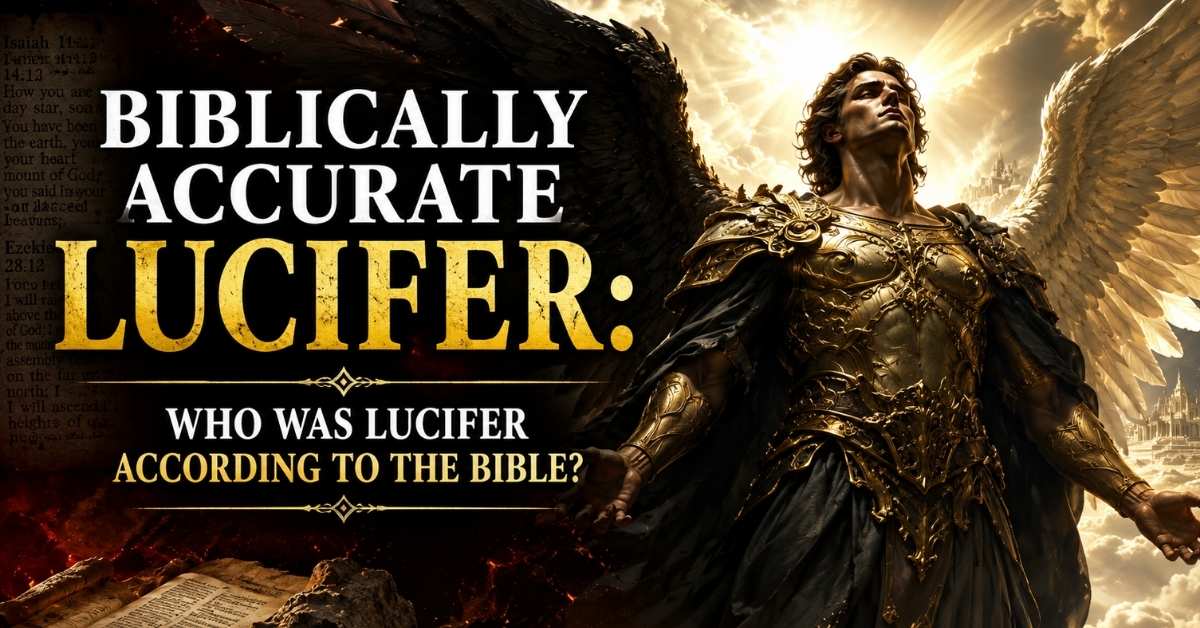
Few figures in religious history have been reshaped by culture as much as Lucifer. Movies, video games, and horror novels have turned him into a red-skinned trickster with horns and a pitchfork. But scripture tells a very different story.
This article breaks down what the Bible actually says about Lucifer: his origin, his description, his fall, and how his image evolved through centuries of art and tradition. Every claim here is grounded in scriptural text, historical translation records, and documented theological scholarship, so you get an accurate picture rather than pop culture fiction.
If you have ever wondered whether Lucifer and Satan are the same being, what he looked like before his fall, or why he is called the “morning star,” this guide answers it clearly and directly.
Biblically Accurate Understanding of Lucifer’s Identity
Lucifer’s identity is one of the most misunderstood topics in biblical study. The name itself never appears as a proper name for a devil figure anywhere in the original Hebrew scriptures.
Understanding who Lucifer really is requires separating three things:
- What the original Hebrew text says
- What later Latin translation added
- What centuries of tradition and pop culture layered on top
See Also: Tristan Name Meaning in the Bible
Common Misconceptions About Lucifer in Modern Culture
Modern media often presents Lucifer as:
- A permanent ruler of hell with a throne room
- A being with red skin, horns, and a tail
- A character interchangeable with “Satan” in every biblical reference
- Someone who mocks God openly and constantly in scripture
None of these details come from the Bible itself. They come from medieval plays, Renaissance poetry, and centuries of folklore that filled in gaps scripture never addressed.
What Scripture Actually Reveals About Lucifer
The single biblical passage most associated with the name “Lucifer” is Isaiah 14:12. In context, this chapter is a taunt against the king of Babylon, using poetic language about a fallen “morning star” who wanted to rise above God.
Many scholars read this passage on two levels:
- A direct historical taunt against a proud Babylonian king
- A secondary spiritual application to a fallen heavenly being, developed later in Christian theology
Ezekiel 28 offers a similar dual reading, addressing the king of Tyre while describing someone who was once in Eden, “the garden of God,” covered in precious stones, and blameless until iniquity was found in him.
The Hebrew Original: Helel and Its True Meaning
The actual Hebrew word in Isaiah 14:12 is “Helel ben Shachar,” meaning “shining one, son of the dawn.” This is a poetic title, not a proper name like a character in a story.
Key points about Helel:
- Helel refers to the visual brightness of the morning star, associated with the planet Venus
- The phrase “son of the dawn” places this figure within a poetic tradition common in ancient Near Eastern literature
- Similar “fallen star” imagery appears in Canaanite mythology describing a lesser god who tried to take a higher god’s throne and failed
This context matters because it shows the original audience would have understood this as poetic judgment language, not a literal biography of a devil.
Jerome’s Latin Vulgate and the Birth of ‘Lucifer’
The name “Lucifer” entered Christian vocabulary through Jerome’s Latin Vulgate translation, completed in the late 4th century. Jerome translated the Hebrew “Helel” into Latin as “Lucifer,” meaning “light-bringer” or “morning star bearer.”
At the time, “Lucifer” was simply the Latin astronomical term for the planet Venus when it appeared before sunrise. It was not originally a proper name for a devil.
| Term | Language | Literal Meaning | Original Context |
| Helel ben Shachar | Hebrew | Shining one, son of dawn | Isaiah 14:12 taunt against Babylon’s king |
| Lucifer | Latin | Light bringer | Jerome’s translation of Helel |
| Morning Star | English | Venus at dawn | Common astronomical reference |
Over centuries, later theologians and writers began applying this title specifically to the fallen angel described in Ezekiel 28 and Revelation 12, cementing “Lucifer” as a proper name in Christian tradition, even though the Hebrew text never uses it that way.
See Also: What Does the Name Tristan Mean in Hebrew?
Biblically Accurate Description of Lucifer’s Appearance
Scripture gives limited but specific details about this being’s original appearance, all tied to his status before his fall rather than after.
Lucifer’s Pre-Fall Glory According to Ezekiel
Ezekiel 28:12 to 14 describes a being who was:
- “The seal of perfection, full of wisdom and perfect in beauty”
- Present “in Eden, the garden of God”
- Covered with precious stones including sardius, topaz, diamond, beryl, onyx, jasper, sapphire, emerald, and gold
- Anointed as a covering cherub, placed on “the holy mountain of God”
This passage describes a created being of extraordinary rank and radiance, not a monstrous or reptilian figure. The stones listed match closely with the gemstones on the breastplate of the high priest in Exodus 28, suggesting a role connected to divine worship and glory.
The Morning Star Imagery in Isaiah’s Prophecy
Isaiah 14:12 describes this figure as one who “weakened the nations” and said in his heart he would ascend above the stars of God. The imagery centers on brightness and elevation, not darkness or physical horror.
The morning star comparison suggests:
- Brilliance and visibility, since Venus is the brightest object in the sky besides the sun and moon
- A position of high honor before the fall, since the imagery draws on radiant light rather than shadow
- A downward fall described in verse 12, moving from heaven to Sheol, the realm of the dead
Does Lucifer Possess Physical Form After His Fall?
Scripture is notably silent on any physical description after the fall. There is no biblical verse describing horns, a tail, red skin, or cloven hooves.
What the New Testament does say:
- 2 Corinthians 11:14 states that Satan disguises himself as “an angel of light,” implying a continued ability to appear radiant rather than monstrous
- 1 Peter 5:8 uses the metaphor of “a roaring lion” to describe his predatory behavior, a simile rather than a literal physical claim
- Revelation 12:9 refers to “that ancient serpent,” again a symbolic title connected to Genesis, not a literal zoological description
What Biblical Silence Tells Us Lucifer Is Not
Given the absence of physical detail, scripture rules out several common cultural depictions:
- No biblical text supports red skin
- No biblical text supports horns or a pitchfork
- No biblical text supports a throne room in hell where he rules eternally in comfort
- No biblical text supports a goat-like or reptilian humanoid form
These images originated centuries later in art, literature, and folk religion, discussed further below.
Critical Distinction Between Lucifer and Satan in Scripture
One of the most important corrections in biblical scholarship is that “Lucifer” and “Satan” are not presented as synonyms within the original Hebrew and Greek texts.
Biblical Evidence Supporting Their Distinction
“Satan” is a Hebrew term meaning “adversary” or “accuser,” used as a title or role rather than a personal name in several Old Testament passages, including Job 1 and Zechariah 3. “Lucifer” appears exactly once in the King James Version, in Isaiah 14:12, as a translation of “Helel.”
Key distinctions:
- Isaiah 14 never uses the Hebrew word for Satan
- The word “Lucifer” never appears in the Hebrew Old Testament or Greek New Testament manuscripts
- Later Christian tradition merged the Isaiah 14 figure with the New Testament adversary figure, creating the composite character popularly known today
How Christian Tradition Merged These Figures
Early church writers, including Origen and Tertullian in the 2nd and 3rd centuries, began reading Isaiah 14 and Ezekiel 28 as descriptions of the same fallen angel referenced in Luke 10:18, where Jesus says he saw “Satan fall like lightning from heaven.”
This interpretive tradition:
- Combined multiple separate passages into one continuous narrative
- Assigned the name “Lucifer” permanently to this composite figure
- Became standard through repetition in sermons, commentaries, and later Latin translations
See Also: Bible Verses About Youth Serving God
Protestant Reformers’ Rejection of the Equation
Interestingly, several Reformation-era scholars questioned the direct equation. John Calvin, in his commentary on Isaiah, argued that the primary meaning of Isaiah 14 referred to the king of Babylon, and warned against over-spiritualizing the text without acknowledging its historical target.
This reflects a broader Reformation principle:
- Prioritizing the plain, contextual meaning of scripture
- Being cautious about doctrines built primarily on typology rather than direct statement
- Treating “Lucifer as Satan” as a theological tradition rather than an explicit biblical claim
Why This Theological Distinction Matters Today
Understanding this distinction matters for a few practical reasons:
- It prevents confusion when reading Isaiah 14 in its actual historical context
- It clarifies that the popular “Lucifer” character is a theological composite, not a name found in the original manuscripts
- It encourages careful, source based Bible study rather than relying on assumptions inherited from tradition or entertainment
Biblically Accurate Account of Lucifer’s Fall and Significance
The fall of this figure is described symbolically across a few key passages, forming the foundation for later Christian doctrine about the origin of evil.
The Narrative of the Fallen Angel in Scripture
The core narrative draws from three passages:
- Isaiah 14:12 to 15, describing a fall from heaven to Sheol due to prideful ambition
- Ezekiel 28:14 to 17, describing corruption of a once blameless cherub due to iniquity and pride in his own beauty
- Revelation 12:7 to 9, describing a war in heaven where the dragon and his angels are cast down to earth
Together, these passages form the traditional doctrine of a heavenly rebellion, even though no single passage tells the complete story in one place.
Lucifer’s Five ‘I Will’ Declarations of Pride
Isaiah 14:13 to 14 contains five statements often called the “five I wills,” representing an escalating claim to divine authority:
- “I will ascend to heaven”
- “I will raise my throne above the stars of God”
- “I will sit on the mount of the congregation”
- “I will ascend above the heights of the clouds”
- “I will make myself like the Most High”
These statements move from ambition to direct self-deification, forming the theological basis for describing his core sin as prideful self-exaltation rather than any external temptation.
The Nature of Sin: Pride in God-Given Perfection
Ezekiel 28:17 states plainly, “Your heart was lifted up because of your beauty; you corrupted your wisdom for the sake of your splendor.” This verse identifies the sin’s root cause with precision.
Important theological point:
- The sin did not originate from a flaw in creation, since verse 15 confirms he was blameless “from the day you were created till iniquity was found in you”
- The sin originated from within, using his own perfection as the basis for pride
- This shows sin can arise from misusing genuine gifts rather than only from lack or deficiency
Catastrophic Consequences of Angelic Rebellion
The consequences described in scripture include:
- Expulsion from his original position, described as being cast “to the ground” in Ezekiel 28:17
- Loss of his former glory and covering role
- Becoming a spectacle before other rulers, per Ezekiel 28:17 to 18
- A future judgment by fire, described symbolically in Ezekiel 28:18
The Scope of Rebellion: One-Third of Angels
Revelation 12:4 describes a dragon whose tail “drew a third of the stars of heaven” and cast them to earth. Most conservative scholars interpret “stars” here as a symbolic reference to angelic beings who joined the rebellion.
This detail suggests:
- The rebellion was not solitary but involved a significant portion of the angelic host
- The imagery of stars connects back to the “morning star” title, reinforcing the identification of these beings as former heavenly light bearers
- This forms the doctrinal basis for the existence of demons as fallen angels rather than a separate class of created beings
Artistic Evolution of Lucifer’s Image Throughout History
The dramatic gap between scripture’s minimal physical description and today’s pop culture image comes almost entirely from centuries of art, literature, and theater.
Early Medieval Period: The Ethereal Blue Angel
In early Byzantine and early medieval Christian art, from roughly the 5th to 10th centuries, this figure was frequently depicted as:
- A blue or dark winged angel, retaining angelic beauty
- Positioned among other angels before his fall, distinguished mainly by color rather than monstrous features
- A being of tragic dignity rather than grotesque horror
This reflects an early theological emphasis on his origin as a genuinely beautiful, high-ranking creation.
High Medieval Transformation to Grotesque Forms
By the 12th and 13th centuries, church art shifted dramatically. Illuminated manuscripts and cathedral carvings began showing:
- Bat-like wings replacing feathered ones
- Animalistic features borrowed from goats, serpents, and mythological satyrs
- Dark or black skin tones intended to visually signal moral corruption
This shift coincided with an increased medieval emphasis on hell as a place of physical torment, using visual horror as a teaching tool for largely illiterate congregations.
Renaissance Romanticization: Milton’s Tragic Rebel
John Milton’s “Paradise Lost,” published in 1667, reshaped the cultural image entirely. Milton portrayed the character as an eloquent, charismatic rebel driven by ambition rather than a cartoonish villain.
This literary work:
- Introduced complex motivation and internal monologue absent from scripture
- Popularized dramatic quotes and a tragic antihero framing
- Heavily influenced centuries of subsequent literature, far more than any single biblical passage
It is important to note Milton’s work is epic poetry, not scripture, though many modern assumptions about this figure’s personality trace directly back to Milton rather than the Bible.
Victorian Era Through Modern: The Theatrical Red Devil
The familiar red-skinned, horned, pitchfork-carrying image solidified during the Victorian era through:
- Theatrical costume design for stage plays, where red was a practical, visible stage color
- Political cartoons using devil imagery for satire
- Early cinema borrowing theatrical costume conventions directly
By the 20th century, film, comics, and video games cemented this visual as the default cultural shorthand, despite having no scriptural basis.
Contrasts Between Artistic and Biblical Portrayals
| Feature | Popular Culture Depiction | Biblical Description |
| Skin color | Red | Not specified |
| Body features | Horns, tail, hooves | Not specified, described as beautiful before the fall |
| Setting | Throne room in hell | Cast down and judged, not enthroned in comfort |
| Personality | Charismatic dealmaker | Accuser and deceiver, per Revelation 12:10 and John 8:44 |
| Origin | Born evil or separate species | Created blameless, corrupted by pride |
Theological Insights from a Biblically Accurate Lucifer
Beyond historical and textual analysis, this figure’s story carries significant theological weight for understanding sin, free will, and spiritual warfare.
The Paradox of Created Perfection and Free Will
Ezekiel 28:15 explicitly states this being was blameless from creation until iniquity was found in him. This raises an important theological point:
- Perfection at creation did not eliminate the possibility of choice
- Free will means even a flawless created being could choose rebellion
- This has shaped Christian doctrine on how evil can exist without accusing God of creating it directly
The Origin of Evil Within a Perfect Being
Theologians often use this narrative to address the classic philosophical question of how evil began in a good creation. The biblical answer, according to most traditional interpretation, is that evil is not a created substance but a corruption of will within a created being.
This distinction matters because:
- It positions evil as a moral choice rather than a physical thing God manufactured
- It places responsibility on the created being’s choice, not on flawed craftsmanship
- It parallels later human temptation narratives, including Genesis 3, where choice rather than nature produces sin
Pride’s Specific Temptation: Giftedness and Position
A recurring theological lesson drawn from Ezekiel 28 and Isaiah 14 is that pride often targets those with genuine gifts, beauty, or high position rather than those lacking anything.
Practical takeaways:
- High ability or high status carries a specific spiritual risk of self-reliance
- The greater the gift, the greater the potential for pride to distort its purpose
- This principle is echoed in Proverbs 16:18, warning that pride precedes destruction
Cosmic Implications: Corrupting Others and Spiritual Warfare
Revelation 12 and Ephesians 6:12 extend this figure’s rebellion into an ongoing cosmic conflict, describing “spiritual forces of evil in the heavenly places” opposing believers.
Key implications include:
- The fall was not an isolated event but the start of continued spiritual conflict
- Scripture frames believers as participants in this conflict, using armor imagery in Ephesians 6:13 to 17
- The New Testament consistently frames this being’s ultimate defeat as certain, per Revelation 20:10
Lessons for Humanity: Humility and Dependence on God
The story functions as a moral warning throughout scripture, most directly echoed in James 4:6, which states God “opposes the proud but gives grace to the humble.”
Applied lessons include:
- Success, talent, or position should increase gratitude rather than self-reliance
- Humility is presented as protective, not merely as a virtue for its own sake
- The narrative reinforces total dependence on God rather than self-exaltation as the safer spiritual posture
Summary
The biblically accurate Lucifer looks nothing like the horned, red-skinned villain of popular culture. He originates from a Hebrew poetic title, “Helel ben Shachar,” describing a radiant, high-ranking being whose pride led to his fall.
Scripture is silent on his post-fall physical form, and much of the modern image comes from medieval art, Milton’s poetry, and Victorian theater rather than the biblical text itself. Understanding this distinction encourages more accurate, source-based Bible study and a clearer grasp of the theological lessons his story was meant to teach: that pride, even in a being of great gifts, leads to downfall, while humility remains the safer path.
Frequently Asked Questions
Is Lucifer a name found in the original Hebrew Bible?
No, the Hebrew text uses “Helel ben Shachar,” meaning shining one, son of the dawn. “Lucifer” comes from Jerome’s Latin translation.
Are Lucifer and Satan the same being in scripture?
The Bible never directly equates them by name. The connection developed through early church tradition merging separate passages.
What did Lucifer look like before his fall?
Ezekiel 28 describes a being of perfect beauty, covered in precious stones, serving as an anointed covering cherub in Eden.
Does the Bible describe Lucifer with horns and red skin?
No, these features come from medieval art and Victorian theater, not any biblical passage.
Why is Lucifer called the morning star?
The title refers to Venus’s brightness at dawn, symbolizing his former high rank and radiance before his prideful fall.
What caused Lucifer’s fall according to the Bible?
Pride in his own beauty and wisdom, along with a desire to exalt himself above God, per Isaiah 14 and Ezekiel 28.
Did other angels fall with Lucifer?
Revelation 12:4 suggests a third of the angels joined the rebellion, forming the biblical basis for the existence of demons.

Charles Turner is the founder and administrator of this prayersglow.com, dedicated to sharing inspiring blessings, meaningful quotes, heartfelt prayers, and Bible-based content. His mission is to encourage faith, hope, and daily spiritual growth by providing uplifting resources that inspire and strengthen readers around the world.