
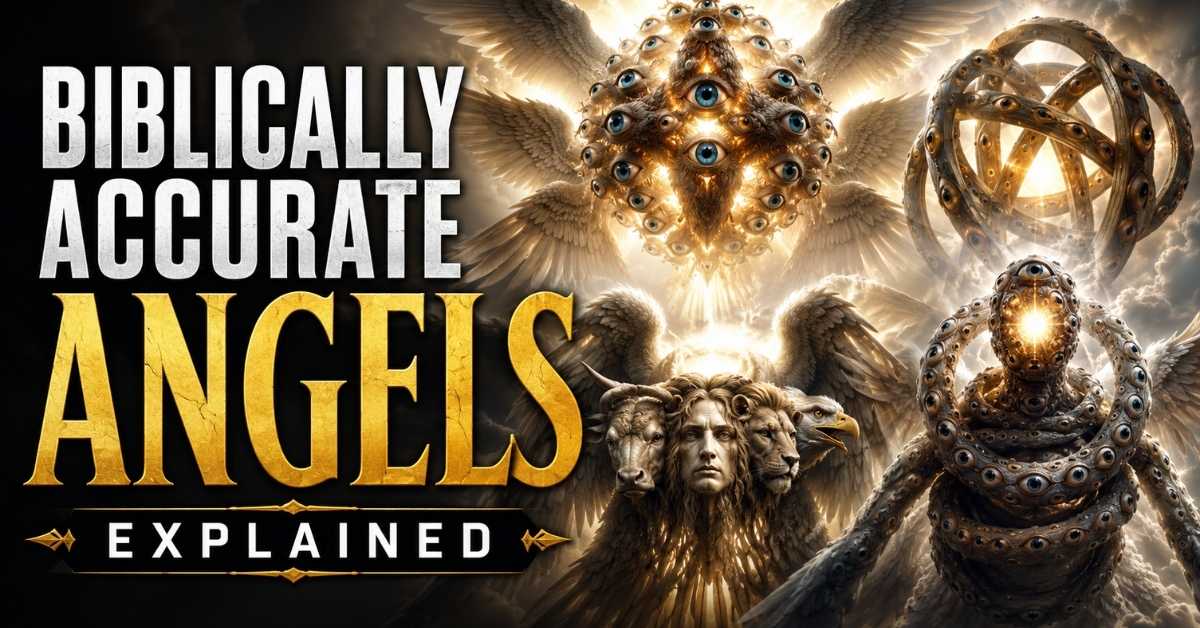
Angels are one of the most misunderstood beings in modern culture. Movies show them as glowing humans with feathered wings and halos. Greeting cards show them as chubby infants floating on clouds.
The Bible tells a very different story. Scripture describes angels as powerful, sometimes terrifying beings with multiple wings, many eyes, and forms that do not match any popular image.
This article breaks down what the Bible actually says about angels. It covers their types, roles, appearances, and meaning, using Scripture as the only source. No movie tropes. No assumptions. Just the biblical text.
The Biblical Foundation of Angels
Angels appear from the first book of the Bible to the last. They are not a side detail. They are woven into the entire biblical narrative as active participants in God’s plan.
What Scripture Reveals About Angels
The Bible presents angels as created beings, not gods and not humans. They exist to serve God’s purposes.
Key facts Scripture establishes about angels:
- They were created by God (Colossians 1:16)
- They existed before the earth was formed (Job 38:4 to 7)
- They do not marry or reproduce (Matthew 22:30)
- They possess great power but are not all-knowing (Matthew 24:36)
- They can appear and disappear from human sight
Angels are mentioned over 270 times across both the Old and New Testaments. This frequency shows they play a consistent, structural role in biblical theology, not a minor or symbolic one.
The Etymology and Meaning of ‘Angel’
The word “angel” comes from the Greek word angelos, meaning “messenger.” The Hebrew equivalent, mal’ak, carries the same meaning.
This is important. The primary biblical function of an angel is not to look beautiful or comforting. It is to deliver a message or carry out a task assigned by God.
- Hebrew: mal’ak meaning messenger or representative
- Greek: angelos meaning messenger or one who is sent
Neither word describes appearance. Both describe function. This is a key distinction lost in popular culture.
Angels as Spiritual Beings and Ministering Spirits
Hebrews 1:14 calls angels “ministering spirits sent to serve those who will inherit salvation.” This verse defines two things at once: their nature and their purpose.
Angels are spirit beings without physical bodies of their own. When they appear to humans, they take on a visible form temporarily, not permanently.
Their core assignment, according to this verse, is service. They minister on behalf of God to people who belong to Him.
Contrasting Biblical Angels with Popular Culture
Few biblical concepts have been altered by media as much as angels. Understanding the gap between fiction and Scripture matters for anyone studying the Bible seriously.
How Modern Media Misrepresents Angels
Popular depictions consistently get angels wrong. Below is a comparison of common myths versus what Scripture actually describes.
| Popular Culture Image | Biblical Description |
| Female angels with soft features | Angels appear as men when taking human form (Genesis 18:2) |
| Baby-faced cherubs (cherubs/putti) | Cherubim have four faces: human, lion, ox, eagle (Ezekiel 1:10) |
| Halos above the head | No mention of halos anywhere in Scripture |
| Small feathered wings | Seraphim have six wings; some angels have four (Isaiah 6:2, Ezekiel 1:6) |
| Angels as deceased humans | Angels are a distinct created order, never former humans |
| Harps and clouds | Angels are shown as warriors, messengers, and throne guardians |
This gap did not appear overnight. It developed through centuries of religious art, Renaissance paintings, and later, film and television, none of which were drawing directly from the original Hebrew or Greek text.
Why Angels Say ‘Fear Not’ in Scripture
There is a detail that reveals just how far off popular imagery really is. Nearly every time an angel appears to a human in the Bible, the first words spoken are some version of “do not be afraid.”
- The angel Gabriel to Mary (Luke 1:30)
- The angel at the tomb to the women (Matthew 28:5)
- The angel to the shepherds (Luke 2:10)
- The angel to Zechariah (Luke 1:13)
This pattern only makes sense if angels are genuinely startling to encounter. A soft, glowing figure with small wings would not require reassurance. A being with an overwhelming, otherworldly appearance would.
See Also: Are Ladybugs a Sign from Angels
Archangels: The Named Messengers of Heaven
Most angels in Scripture remain unnamed. Only a small number are given specific names and titles, and these hold special rank within angelic hierarchy.
Michael: The Warrior Prince
Michael is called “the great prince” in Daniel 12:1 and is the only angel directly called an archangel in Scripture (Jude 1:9). His role is consistently military and protective.
- He fights for Israel against opposing spiritual forces (Daniel 10:13)
- He leads heaven’s armies against the dragon in Revelation 12:7
- He disputes with the devil over Moses’ body (Jude 1:9)
Michael’s function centers on spiritual warfare and the defense of God’s people, particularly Israel.
Gabriel: God’s Chief Herald
Gabriel appears whenever a major announcement needs to be delivered. He identifies himself as one who “stands in the presence of God” (Luke 1:19), suggesting a position of high rank.
Gabriel’s recorded appearances:
- Interpreting Daniel’s vision (Daniel 8:16)
- Explaining the prophecy of seventy weeks (Daniel 9:21 to 22)
- Announcing John the Baptist’s birth to Zechariah (Luke 1:19)
- Announcing Jesus’ birth to Mary (Luke 1:26 to 38)
Unlike Michael, Gabriel is never shown fighting. His role is communication of critical divine messages at turning points in biblical history.
The Unique Role of Named Angels
Named angels appear at moments of major theological significance. This is not a coincidence.
Scripture reserves personal names for angels involved in pivotal events, such as the incarnation of Christ or major end times conflict. This suggests named status reflects both rank and the weight of their assignment.
Seraphim: The Fiery Worshipers at God’s Throne
Seraphim appear only once by name in Scripture, in Isaiah’s vision of God’s throne room. Their description is unlike anything in popular imagery.
The Six Wings and Their Symbolic Meaning
Isaiah 6:2 describes seraphim as having six wings, each with a specific function.
- Two wings covered the face
- Two wings covered the feet
- Two wings were used for flying
This wing arrangement communicates reverence and humility even among the highest heavenly beings. Covering the face suggests even seraphim cannot look directly at God’s glory. Covering the feet signals humility before holiness.
See Also: Biblically Accurate Lucifer
The Threefold Holy Proclamation
Seraphim are recorded declaring, “Holy, holy, holy is the Lord Almighty” (Isaiah 6:3). The threefold repetition is a Hebrew literary device used for maximum emphasis, the highest possible degree of a quality.
This proclamation is so significant it appears again in Revelation 4:8, spoken by the four living creatures around God’s throne, showing continuity between Old and New Testament throne room imagery.
Seraphim’s Role in Purification
In Isaiah 6:6 to 7, a seraph takes a burning coal from the altar and touches Isaiah’s lips, declaring his guilt removed and sin atoned for.
This is the only recorded direct action seraphim take in Scripture. It connects them to purification and holiness, fitting their name, which derives from a Hebrew root meaning “to burn.”
Cherubim: The Multi-Faced Guardians of Holy Places
Cherubim are the most frequently mentioned angelic class tied to sacred spaces. Their job centers on guarding access to what is holy.
Cherubim Guarding the Garden of Eden
After Adam and Eve were removed from Eden, God placed cherubim with a flaming sword at the entrance to guard the way to the tree of life (Genesis 3:24).
This is the first mention of any angelic being in Scripture, and it establishes their guardian role from the very beginning of the biblical narrative.
The Four Faces and Their Significance
Ezekiel 1:10 describes cherubim with four faces:
- A human face
- A lion’s face
- An ox’s face
- An eagle’s face
Each face likely represents a category of creation: humanity, wild animals, domesticated animals, and birds. Together, the four faces symbolize cherubim overseeing all of creation on God’s behalf.
Cherubim on the Ark of the Covenant
God instructed Moses to place two golden cherubim on top of the Ark of the Covenant, facing each other with wings spread over the mercy seat (Exodus 25:18 to 20).
This design was not decorative. God stated He would meet with Moses “from above the mercy seat, from between the two cherubim” (Exodus 25:22), making cherubim symbolic guardians of God’s presence itself.
Eyes Symbolizing God’s Omniscience
Ezekiel’s vision describes cherubim, and the wheels associated with them, as full of eyes all around (Ezekiel 10:12). This detail is unsettling by design.
The eyes represent complete awareness. Nothing escapes the sight of these beings, reflecting the all seeing nature of the God they serve and guard.
Living Creatures and Ophanim: The Most Mysterious Angels
Some of the strangest angelic descriptions in Scripture come from Ezekiel and Revelation. These beings defy simple categorization.
Ezekiel’s Vision of the Living Creatures
Ezekiel 1 describes four living creatures with human-like forms, four faces each, four wings each, and legs like a calf’s leg with feet like burnished bronze (Ezekiel 1:5 to 7).
They moved in perfect coordination, never turning as they moved, and were accompanied by flashes of lightning and a sound like rushing water.
The Wheel Angels: Ophanim Explained
Alongside the living creatures, Ezekiel describes wheels on the ground, one beside each creature, described as “a wheel intersecting a wheel” (Ezekiel 1:16).
These wheel-like beings are often referred to as ophanim, a term derived from the Hebrew word for “wheels.” While not called angels directly by name, their integration with the living creatures links them to the same heavenly order.
Wheels Within Wheels Covered With Eyes
Ezekiel 10:12 adds that the entire body, including the wheels, was covered with eyes. The wheels moved in any direction without turning, and their spirit was tied directly to the spirit of the living creatures above them.
This unified movement suggests these beings function as an extension of God’s throne itself, moving wherever His presence directs.
The Relationship Between Living Creatures and Cherubim
Ezekiel 10:20 directly identifies the living creatures from chapter 1 as cherubim. This connection matters for understanding angelic classification.
- Living creatures and cherubim appear to describe the same class of being
- Their primary location is near God’s throne
- Their described appearance shifts slightly between visions, possibly due to the limits of human language describing divine beings
General Angels: The Messengers Throughout Scripture
Beyond named archangels and throne guardians, the Bible describes a large category of general angels carrying out God’s commands across both testaments.
Angels Appearing in Human Form
Angels frequently appear indistinguishable from ordinary men. Abraham hosted three visitors, later revealed to include angels, and offered them a meal (Genesis 18:1 to 8).
Hebrews 13:2 references this pattern directly, warning believers to show hospitality to strangers, “for by so doing some people have shown hospitality to angels without knowing it.”
The Mighty Acts Angels Perform
Angels in Scripture are shown performing significant, often physically powerful acts:
- Destroying Sodom and Gomorrah (Genesis 19:13)
- Striking down 185,000 Assyrian soldiers in one night (2 Kings 19:35)
- Rolling away the stone from Jesus’ tomb (Matthew 28:2)
- Freeing Peter from prison (Acts 12:7 to 10)
- Striking Herod dead for accepting worship as a god (Acts 12:23)
Angels Holding Swords as Warriors
Several passages show angels armed and ready for combat. The angel guarding Eden carries a flaming sword (Genesis 3:24). Joshua encounters “the commander of the Lord’s army” holding a drawn sword (Joshua 5:13 to 14).
This military imagery reinforces that angels are not passive figures. They actively engage in conflict on behalf of God’s purposes.
Angels in the Life and Ministry of Christ
Angels play a direct, active role throughout the life of Jesus, appearing at nearly every major turning point.
Angelic Announcements of Jesus’ Birth
Gabriel announces the coming births of both John the Baptist and Jesus. An angel later appears to Joseph in a dream, confirming Mary’s pregnancy is from the Holy Spirit (Matthew 1:20 to 21).
A multitude of angels appears to shepherds outside Bethlehem, praising God and announcing Christ’s birth (Luke 2:13 to 14).
Angels Ministering to Jesus During His Earthly Life
After Jesus faced temptation in the wilderness for forty days, angels came and ministered to Him (Matthew 4:11).
In the Garden of Gethsemane, before His arrest, an angel appeared to strengthen Him during His most intense moment of anguish (Luke 22:43).
Angels at the Resurrection and Ascension
Angels appear at the empty tomb, announcing the resurrection to the women who came to anoint Jesus’ body (Matthew 28:2 to 7).
At the ascension, two angels appear to the disciples, confirming Jesus will return in the same way He departed (Acts 1:10 to 11).
Jesus’ Teaching About Angels and Judgment
Jesus taught that angels will play a direct role in final judgment. He described angels separating the righteous from the wicked at the end of the age (Matthew 13:49 to 50).
He also stated that when He returns, He will come “with His angels in the glory of His Father” (Matthew 16:27), tying angelic presence directly to His future return.
Angelic Activity in Acts and the Early Church
The book of Acts shows angels actively involved in the growth and protection of the early church.
Angels Guiding the Spread of the Gospel
An angel directs Philip to meet the Ethiopian eunuch on a desert road, a divine appointment that leads to the man’s conversion (Acts 8:26).
This shows angels playing a strategic role in guiding specific evangelistic encounters, not just delivering general messages.
Angels Executing Divine Judgment
Angels are also shown carrying out judgment in the early church period. Herod Agrippa, after accepting worship from a crowd instead of giving glory to God, is struck down by an angel and dies (Acts 12:21 to 23).
This confirms the pattern seen in the Old Testament, where angels serve as instruments of both blessing and judgment.
Paul’s Theological Insights About Angels
Paul’s letters add theological depth to the understanding of angels, addressing their nature, limits, and future.
- Angels observe the church’s conduct (1 Corinthians 4:9)
- Believers will one day judge angels (1 Corinthians 6:3)
- Even angels are not exempt from teaching sound doctrine, warned against preaching a false gospel (Galatians 1:8)
- Angels do not deserve worship, only God does (Colossians 2:18)
Angels in the Book of Revelation
Revelation contains more angelic activity than any other New Testament book, particularly tied to end times events.
Seven Angels With Seven Trumpets
Revelation 8 introduces seven angels given seven trumpets. Each trumpet blast triggers a distinct judgment on the earth, including hail and fire, a burning mountain cast into the sea, and darkened skies.
| Trumpet | Judgment Released |
| First | Hail and fire mixed with blood strike the earth |
| Second | A burning mountain thrown into the sea |
| Third | A star called Wormwood poisons fresh water |
| Fourth | A third of sun, moon, and stars darkened |
| Fifth | Demonic locusts released from the abyss |
| Sixth | Four bound angels released to kill a third of humanity |
| Seventh | Announces the kingdom of God has come |
Angels Pouring Out God’s Wrath
Revelation 16 describes seven angels pouring out bowls of God’s wrath, a final and more intense series of judgments than the trumpets, including sores, seas turning to blood, and scorching heat.
These bowl judgments represent the completion of God’s judgment before final victory, as stated in Revelation 15:1.
Michael’s War Against the Dragon
Revelation 12:7 to 9 describes a war in heaven where Michael and his angels fight against the dragon, identified as Satan, and his angels. Michael’s forces win, and the dragon is cast down to earth.
This passage confirms angelic conflict is not only historical but also directly tied to end times prophecy.
The Angel Binding Satan
Revelation 20:1 to 3 describes an angel coming down from heaven with the key to the abyss and a great chain, seizing Satan and binding him for a thousand years.
This act shows angelic authority extending even over Satan himself, under God’s direct command.
The Biblical Truth About Guardian Angels
The idea of a personal guardian angel is popular, but Scripture’s actual teaching is more nuanced than common assumptions suggest.
What Scripture Actually Teaches About Personal Protection
Psalm 91:11 states God “will command His angels concerning you to guard you in all your ways.” Jesus also references children having angels who “always see the face of my Father” (Matthew 18:10).
These verses support angelic protection but do not explicitly confirm a single, permanently assigned angel per individual person.
Communal Versus Individual Angelic Ministry
Scripture more consistently describes angelic protection in general or communal terms rather than a fixed one to one assignment.
- Angels are described protecting groups, such as Israel
- Angels respond to specific situations, as with Peter’s release from prison (Acts 12:7)
- The disciples assumed Peter’s “angel” appeared at the door, suggesting the concept of personal angels existed in first century Jewish thought (Acts 12:15)
Angels Assigned to Nations and Groups
Daniel 10:13 and 10:20 reference a “prince of Persia” and “prince of Greece,” terms understood as spiritual beings assigned influence over specific nations, with Michael identified as Israel’s assigned prince.
This suggests angelic assignment operates at both national and situational levels, not exclusively as an individual lifelong companion.
Satan’s Fall and the Origin of Fallen Angels
Not all angels remained faithful to God. Scripture describes a rebellion led by a being of high angelic rank.
Satan as a Fallen Cherub
Ezekiel 28:14 to 16, often interpreted as referring to Satan through the king of Tyre, describes a guardian cherub who was blameless until wickedness was found in him, resulting in his expulsion.
This passage suggests Satan originally held a high position, possibly among the cherubim, before his fall.
The Meaning of ‘Satan’ and ‘Lucifer’
“Satan” comes from a Hebrew word meaning “adversary” or “accuser.” “Lucifer,” used in some translations of Isaiah 14:12, comes from a Latin term meaning “morning star” or “light bearer,” referencing a description of the fallen king of Babylon later linked to Satan by many theologians.
- Satan: adversary, accuser
- Lucifer: light bearer, morning star (Latin Vulgate rendering)
Pride as the Root of Angelic Rebellion
1 Timothy 3:6 warns against appointing new believers to leadership, stating they might become “puffed up with conceit and fall into the condemnation of the devil,” directly linking Satan’s downfall to pride.
Isaiah 14:13 to 14 describes this rebellion in direct terms, with the fallen figure declaring intent to raise his throne above God’s, revealing ambition as the root cause of the fall.
Other Fallen Angels: Demons and Spiritual Rebellion
Satan was not alone in rebellion. Scripture describes other angelic beings who also turned away from God’s authority.
The Sons of God in Genesis Six
Genesis 6:1 to 4 describes “sons of God” taking human wives, resulting in offspring called Nephilim. Many scholars interpret “sons of God” here as a reference to fallen angelic beings, based on similar phrasing used elsewhere in the Old Testament for heavenly beings (Job 1:6).
This event is presented as a significant factor contributing to the widespread corruption that led to the flood.
Angels Bound in Chains of Darkness
2 Peter 2:4 states that God did not spare the angels who sinned, but “sent them to hell, putting them in chains of darkness to be held for judgment.”
Jude 1:6 confirms this, describing angels who did not stay within their proper authority as being kept in eternal chains for judgment on the last day.
Demons and Unclean Spirits in the New Testament
The New Testament frequently records Jesus and His disciples encountering demons, also called unclean spirits, causing physical illness, possession, and torment.
- Demons recognize Jesus’ authority and identity immediately (Mark 1:24)
- Jesus casts out demons with a spoken command, not ritual (Mark 1:25 to 26)
- Demons operate under a hierarchy, referencing “the prince of demons” (Matthew 12:24)
- Believers are given authority over unclean spirits in Jesus’ name (Luke 10:17)
Summary
The Bible presents angels as far more complex and powerful than popular culture suggests. They are created spirit beings assigned to serve, protect, deliver messages, and execute God’s judgment.
Different classes exist, including archangels, seraphim, cherubim, living creatures, and general messenger angels, each with distinct roles and appearances described in specific biblical passages.
Not all angels remained faithful. Satan’s rebellion, along with other fallen angels, introduced ongoing spiritual conflict described throughout Scripture, from Genesis to Revelation.
Understanding angels through the biblical text, rather than through art or film, offers a far more accurate and theologically grounded picture of these beings and their role in God’s plan.
Frequently Asked Questions
What do angels really look like according to the Bible?
Angels appear as men, as multi-winged fiery beings, or as multi-faced creatures with eyes, depending on the biblical passage. There is no single standard biblical description.
Do all angels have wings?
No. Many angels appear in human form without wings, while seraphim have six wings and cherubim have four wings, according to Isaiah and Ezekiel.
How many types of angels are mentioned in the Bible?
Scripture names or describes several distinct types, including archangels, seraphim, cherubim, living creatures, ophanim, and general messenger angels.
Is Satan an angel?
Yes. Satan is described as a fallen cherub who rebelled against God due to pride, according to Ezekiel 28 and related passages.
Does everyone have a personal guardian angel?
Scripture supports general angelic protection but does not clearly confirm a single, permanently assigned angel for every individual person.
Who are the only two angels named in the Bible?
Michael and Gabriel are the only angels given specific names in Scripture, with Michael identified as an archangel in Jude 1:9.
Can humans become angels after death?
No. The Bible describes angels as a separate created order from humans, never as humans who have died and transformed.

Charles Turner is the founder and administrator of this prayersglow.com, dedicated to sharing inspiring blessings, meaningful quotes, heartfelt prayers, and Bible-based content. His mission is to encourage faith, hope, and daily spiritual growth by providing uplifting resources that inspire and strengthen readers around the world.