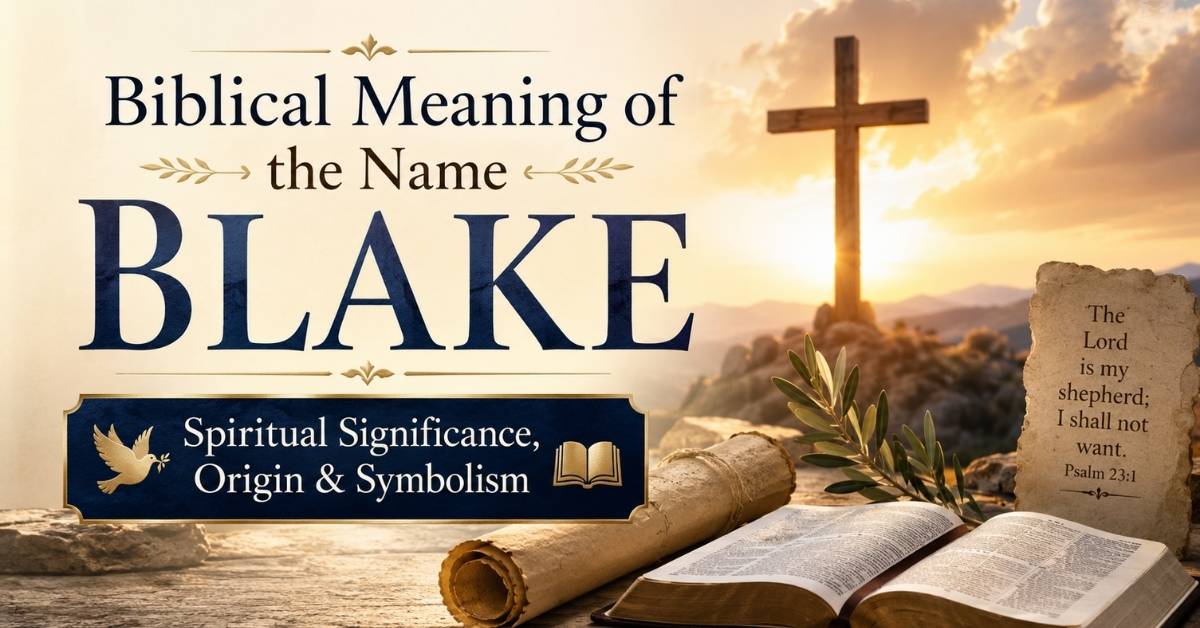
The name Blake carries a quiet but powerful duality. It can mean both “dark” and “fair” or “bright,” depending on its Old English roots. This contrast is not just a linguistic curiosity. It mirrors one of the most repeated themes in Scripture: the movement from darkness into light.
If you are considering the name Blake for a child, exploring your own name’s meaning, or simply curious about its spiritual weight, this guide breaks it down clearly. You will learn where the name comes from, what it symbolizes in a biblical sense, and how its meaning can apply to everyday faith.
Discovering Blake’s Linguistic and Spiritual Roots
Names often hold more history than people realize. Blake is a strong example of this, since its meaning has shifted and split over centuries.
Understanding where a name comes from helps explain why it carries the symbolism it does today.
Origins of the Name Blake
Blake originates from Old English. It developed from two separate words that, over time, merged into one surname and later a first name.
- Blæc, meaning black or dark
- Blac, meaning pale, bright, or fair
Because these two Old English words sounded similar and were spelled inconsistently in early records, they blended into a single surname: Blake.
- Originally used as a descriptive nickname for someone with dark hair or a dark complexion
- Also used for someone notably pale or fair skinned
- Became a hereditary surname in medieval England
- Later adopted as a given first name, especially from the 20th century onward
This dual origin is why Blake is often described as a name meaning “fair-haired” and “dark” at the same time. Rather than being confusing, this duality is what gives the name its symbolic depth.
See Also: Biblically Accurate Lucifer
Blake in Historical and Cultural Context
The surname Blake appears in English records as early as the medieval period, often tied to specific families and regions.
- Recorded in England before the 12th century as an occupational or descriptive surname
- Carried by notable historical figures, including poet and artist William Blake
- Spread through Ireland and Scotland through Anglo-Norman settlement
- Became popular as a first name in the United States and United Kingdom from the late 1900s onward
William Blake, the English poet, is one of the most recognized bearers of the name. His own work frequently explored spiritual themes, innocence, and the tension between light and darkness, which adds an interesting layer to how people associate the name with deeper meaning today.
- The name is unisex in modern usage, though historically more common as a surname
- It ranks consistently among popular baby names in English-speaking countries
- It carries no single fixed meaning in official name registries, which is why interpretations vary
The Biblical Symbolism Hidden Within Blake
Blake is not a name found directly in the Bible. There is no biblical figure named Blake in either the Old or New Testament.
However, the core meaning behind the name connects strongly to biblical symbolism, particularly the recurring theme of light and darkness found throughout Scripture.
Biblical Symbolism of Blake: Darkness and Light
The Bible uses darkness and light as central symbols from its opening chapter to its closing pages.
| Theme | Biblical Reference | Symbolic Meaning |
| Creation of light | Genesis 1:3 | Order emerging from chaos |
| Light of the world | John 8:12 | Christ as guidance and truth |
| Darkness to light | 1 Peter 2:9 | Spiritual transformation |
| Children of light | Ephesians 5:8 | Living a righteous life |
| Eternal light | Revelation 21:23 | Heavenly glory without darkness |
Because Blake’s Old English roots touch both “dark” and “fair or bright,” the name naturally lines up with this well-established biblical pattern.
- Darkness in Scripture often represents sin, confusion, or separation from God
- Light in Scripture often represents truth, guidance, and God’s presence
- The movement from one to the other is a recurring picture of redemption
Darkness Turned to Light
One of the clearest biblical patterns is the transformation from darkness into light. This is not presented as a single event but as an ongoing spiritual journey.
- Genesis begins with darkness over the deep before light is spoken into existence
- The Israelites moved from captivity in darkness toward the light of the Promised Land
- The New Testament describes believers as once being darkness but now light in the Lord
This pattern gives the name Blake a meaningful lens. A name rooted in both dark and light can be seen as symbolic of a life journey, starting in struggle or uncertainty and moving toward clarity and purpose.
- It reflects personal growth
- It reflects spiritual awakening
- It reflects the biblical idea that transformation is always possible
See Also: What Is the Biblically Accurate Satan?
The Call to Shine
Beyond the shift from darkness to light, the Bible repeatedly calls believers to actively shine that light for others.
- Matthew 5:14 to 16 describes believers as the light of the world and instructs them not to hide it
- Philippians 2:15 encourages shining like stars in a warped and crooked generation
- Proverbs 4:18 compares the path of the righteous to the light of dawn, growing brighter
For someone named Blake, this can serve as a personal reminder rather than a strict definition. The name’s connection to brightness or fairness pairs naturally with this biblical call to reflect light outward, not just experience it internally.
- Living with honesty and integrity
- Offering encouragement to others
- Standing firm even in difficult circumstances
Living Out Blake’s Spiritual Heritage
A name’s meaning becomes most valuable when it moves from history books into daily life. This section looks at how the symbolism behind Blake can be applied practically.
Spiritual Lessons from the Name Blake
The dual meaning of Blake offers several practical spiritual lessons, especially for parents naming a child or individuals reflecting on their own name.
- No one is defined only by their struggles or their “dark” seasons
- Growth and clarity are always possible, even after confusion or hardship
- Identity is not fixed by circumstance but shaped by ongoing transformation
These lessons are not unique to Blake alone, but the name’s built-in contrast makes them easier to connect with directly.
- A season of difficulty does not define a person’s entire story
- Bright moments often follow periods of struggle
- Balance between contrasts often reflects a fuller, more honest life
Blake and the Christian Life
For Christians specifically, the darkness and light theme tied to Blake can be applied to everyday faith practice.
- Reading Scripture as a way to bring clarity to confusing seasons
- Prayer as a way to move from uncertainty toward peace
- Community and church involvement as a way to reflect light to others
Practical ways this can look in daily life:
- Starting the day with a short devotional or prayer
- Being intentional about honesty in relationships
- Choosing encouragement over criticism when interacting with others
- Reflecting weekly on personal growth, not just daily tasks
None of these practices require the name Blake specifically, but the symbolism behind the name can serve as a helpful personal reminder for anyone who carries it.
A Broader Reflection on Light and Darkness
Zooming out, the light and darkness theme extends beyond any single name. It is one of the most universal symbols across Scripture and, more broadly, across most world literature and philosophy.
- Light is almost universally associated with knowledge, truth, and hope
- Darkness is almost universally associated with fear, confusion, or the unknown
- The movement between the two often represents personal or collective growth
This is part of why names like Blake resonate with people beyond religious context as well. The symbolism is broad enough to apply to personal growth, career journeys, recovery from hardship, or simple day to day resilience.
- Applicable in personal development contexts
- Applicable in mental health and resilience conversations
- Applicable in general life story reflection, not only religious settings
FAQ’s
Is Blake a name found in the Bible?
No, Blake does not appear as a name in the Bible. Its biblical connection comes from its symbolic meaning, not a direct scriptural reference.
What does the name Blake mean spiritually?
Spiritually, Blake is often linked to the biblical theme of darkness turning into light. This reflects transformation, growth, and clarity over time.
Is Blake a biblical name or just a popular name?
Blake is a popular English name, not an original biblical name. Its spiritual meaning is drawn by connecting its dual origin to biblical light and darkness themes.
What is the Old English meaning of Blake?
Blake comes from Old English words meaning both black or dark and pale or fair. This dual meaning is why it is linked to contrast and transformation.
Can Blake be used for both boys and girls?
Yes, Blake is a unisex name commonly used for both boys and girls in modern naming trends. It was historically more common as a surname.
Why is Blake associated with light and darkness in Christianity?
Because its root words mean both dark and bright, people often connect it to the biblical pattern of moving from darkness into light. This is a common way names are given deeper meaning.
Is there a famous Christian or biblical figure named Blake?
There is no biblical figure named Blake. However, poet William Blake is historically notable and often explored spiritual and light versus darkness themes in his work.
Conclusion
The name Blake may not appear in Scripture, but its meaning naturally connects to one of the Bible’s most consistent themes: the movement from darkness into light. Rooted in Old English words for both “dark” and “fair,” Blake carries a built-in symbolism of contrast, growth, and transformation.
Whether you are naming a child, exploring your own identity, or simply drawn to the meaning behind names, Blake offers a reminder that no season of darkness is permanent. Growth, clarity, and light are always part of the journey.
If this meaning resonates with you, it can serve as a simple but powerful personal reflection: every part of your story, both the dark seasons and the bright ones, contributes to a fuller, more meaningful life.

Charles Turner is the founder and administrator of this prayersglow.com, dedicated to sharing inspiring blessings, meaningful quotes, heartfelt prayers, and Bible-based content. His mission is to encourage faith, hope, and daily spiritual growth by providing uplifting resources that inspire and strengthen readers around the world.